What Kind of Shoes Are Best for Traveling in India?
A Jaipur Tour Guide's Completely Honest Answer
By Mukesh Sain | Senior Tour Guide & Founder, My Dream India Tour Last Updated: 2026
Let me start with a story.
A few years ago, I picked up a lovely couple from Texas at Jaipur airport for the start of their Rajasthan tour. They were excited, well-prepared, and had clearly done their research. But when I glanced down at their feet, my heart sank a little.
Brand new leather hiking boots. Both of them. Still with the shop creases in the leather.
By the time we reached Amber Fort the next morning — just our second stop of the day — the husband had a blister the size of a small coin on his left heel. By Day 3 in Jodhpur, both of them were grimacing on the cobblestones outside Mehrangarh Fort. By Day 4, I was making an emergency stop at a Jaisalmer market to buy them a pair of local sandals for ₹400 each.
Those Indian sandals carried them comfortably through the rest of the trip. The expensive hiking boots went into the bottom of the suitcase and never came out again.
I have seen versions of this story play out hundreds of times. And it is why I am writing this guide — so your feet have a genuinely great India trip, from Day 1 to your last day.
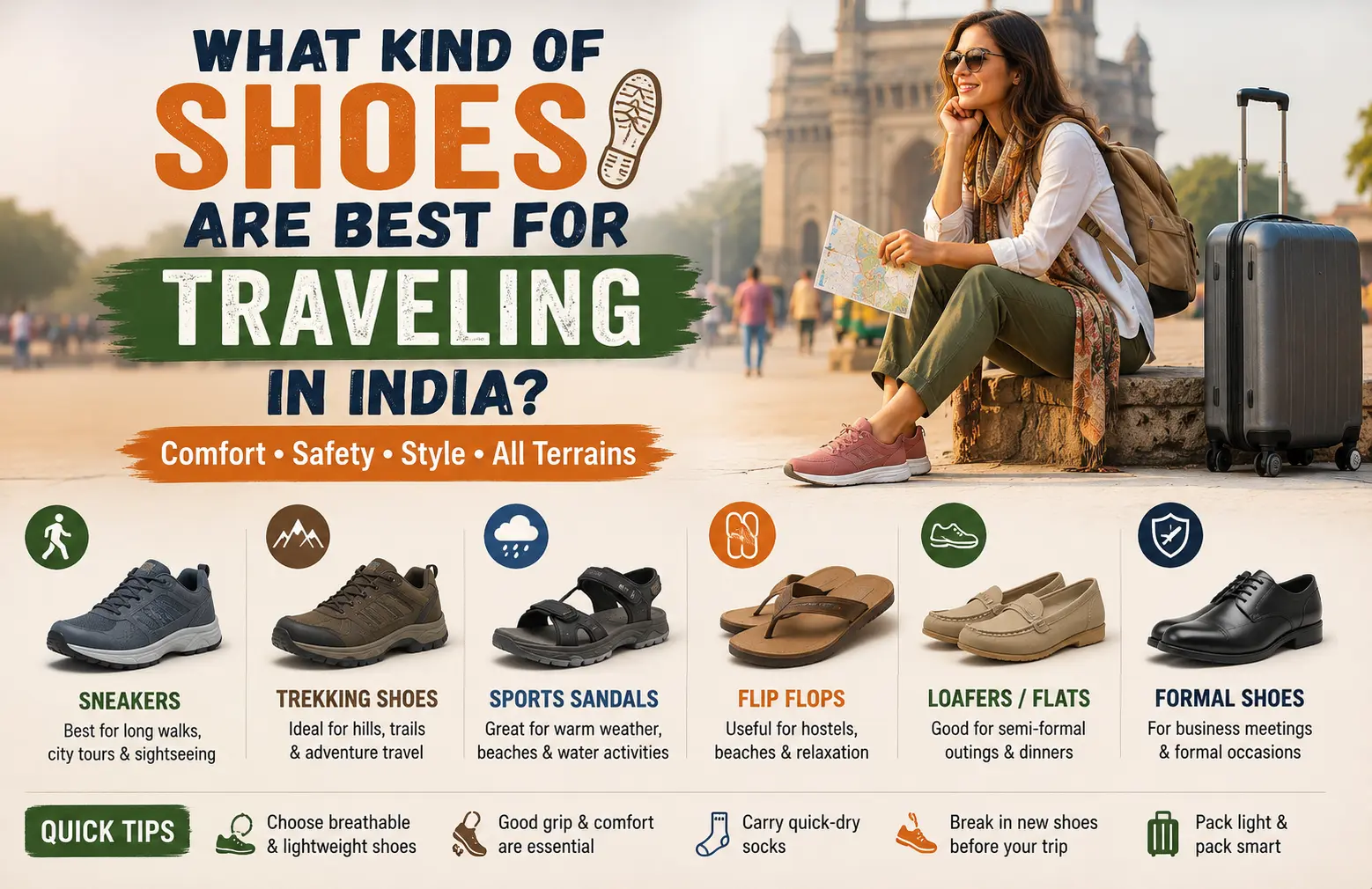
The best shoes for traveling in India are:
- Slip-on sandals with good arch support (for temples, markets, and warm-weather sightseeing)
- Broken-in lightweight walking shoes or trainers (for fort walks, city exploration, and cooler months)
- Flip-flops (for hotel use and beach destinations only)
The single most important rule: never bring new shoes to India. Break them in at home first — always.
The second most important rule: choose shoes you can slip off quickly — you will remove them dozens of times at temple and mosque entrances throughout your trip.
Why India Is Different From Every Other Destination
Before I give you my specific recommendations, I want you to understand why shoe choice matters more in India than in most other international destinations.
1. You Will Walk More Than You Expect
India's greatest sights — Amber Fort in Jaipur, Mehrangarh in Jodhpur, Chittorgarh, the old city of Varanasi, Old Delhi's lanes — involve significant walking on uneven, ancient stone surfaces. Comfortable shoes are not a luxury. They are the difference between a good day and a miserable one.
2. You Will Remove Your Shoes Constantly
Add to that the cultural aspects of taking your shoes off before entering any temple in India, which means if you go temple-hopping, you must wear something that you can easily slip in and out of. In a typical Rajasthan itinerary, you might remove your shoes 8 to 12 times in a single day. Laced shoes become genuinely tedious. Shoes that are difficult to put on and take off waste minutes that compound into frustration across a long sightseeing day.
3. Surfaces Are Varied and Often Unforgiving
India's terrain is extraordinarily diverse — smooth marble floors inside the Taj Mahal, irregular centuries-old cobblestones at Mehrangarh, dusty unpaved lanes in Rajasthani villages, hot stone temple courtyards, modern tarmac city roads, and sometimes (if you are doing a wildlife safari) dirt tracks and forest paths — often all in the same day.
4. Heat and Dust Are Real Factors
Rajasthan's temperatures between March and October regularly exceed 35°C (95°F). Heavy, non-breathable shoes in that heat are deeply uncomfortable. It is very hot and humid in most parts of India. Mesh or fabric shoes work the best as they can be used when the feet swell due to heat and humidity and can provide a good number of options for breathable shoes for the Indian climate.
The Best Shoe Types for India — Ranked by a Tour Guide
1. Slip-On Sandals with Arch Support
(My Top Recommendation for Most India Travellers)
If I could give every international guest arriving in India one piece of footwear advice, it would be this: bring a quality pair of slip-on sandals with good arch support — and make them your primary shoe for the entire trip.
Sandals are ideal for warmer climates and casual outings. They allow breathability and are easy to take on and off, which is useful for visiting temples or homes where shoes need to be removed. Popular sandal brands include Birkenstock and Teva, known for their comfort.
Why slip-on sandals work so well in India specifically:
- They are off your foot in two seconds at every temple gate
- They breathe in heat that would make enclosed shoes miserable
- Quality sandals (Birkenstock, Teva, Ecco) provide the arch support needed for long fort walks
- They are easy to clean after dusty bazaar days
- They work in every context — sightseeing, dinner, markets
What to look for:
- Adjustable straps — not just toe-post flip-flops
- Cushioned footbed with genuine arch support
- Rubber sole with grip — temple courtyards and fort paths can be slippery after rain or cleaning
- Broken in before you travel — this is non-negotiable
Brands I see working well on India tours: Birkenstock Arizona, Teva Hurricane, Ecco Yucatan, Keen Newport. All provide the right combination of support, durability, and easy on-off that India demands.
My honest local tip: On Day 1 or 2 of your Jaipur tour, walk through Bapu Bazaar and buy a pair of hand-stitched Kolhapuri sandals. They cost ₹400–₹800 (roughly $5–$10 USD), are made from soft leather, designed for India's terrain and heat, and are extraordinarily comfortable once broken in. Half my guests end up wearing them for the rest of their trip and carrying them home as a souvenir. I have guests from California who still email me about their Kolhapuri sandals three years later.
2. Broken-In Lightweight Walking Shoes / Trainers
(Essential for Fort Walks, Cooler Months & City Days)
A good pair of well-worn lightweight trainers or walking shoes is the second essential of any India shoe kit — particularly for October to February travel when Rajasthan mornings are genuinely cool (sometimes as low as 8°C / 46°F in January), and for long fort walks where extra ankle support is helpful.
Comfortable walking shoes are your workhorses. Opt for well-broken-in sneakers made of breathable materials like canvas or mesh. They provide excellent support for long days of sightseeing, navigating crowded markets, and walking on varied surfaces.
When walking shoes are specifically the right choice:
- Long fort walks — Chittorgarh Fort is enormous (700 acres). Kumbhalgarh's walls stretch 36 km. Mehrangarh has multiple steep staircases. For these, enclosed shoes with good grip and ankle support serve you better than sandals.
- Wildlife safaris — Ranthambore and Jim Corbett involve walking on forest tracks and boarding open jeeps. Closed walking shoes keep out dust and insects.
- Cool winter mornings — December and January early starts at Amber Fort or Taj Mahal sunrise visits are cold. Sandals in 8°C with your toes exposed is genuinely uncomfortable.
- Rainy days — monsoon season (July–September) turns Rajasthan's streets into mud. Enclosed shoes keep feet significantly drier.
The golden rule I cannot stress enough: Preferably, pick shoes which you have worn before and not new ones because you are simply not used to it, and you don't know whether it will throw any surprises. Walk in them for at least two to three weeks before your India trip. Your feet will thank you on Day 1.
Brands that work well on India tours: Clarks walking shoes (very popular with UK travellers — the rubber soles handle India's cobblestones beautifully), Merrell Moab trail shoes, Sketchers GOwalk series, On Cloud lightweight trainers. All breathable, all lightweight, all proven on India's varied terrain.
3. Flip-Flops
(Hotel, Pool, and Beach Use Only)
Flip-flops have a very specific and limited role in an India shoe kit — and understanding that limitation is important.
Where flip-flops ARE the right choice:
- Hotel rooms, pool areas, and shared bathrooms
- Goa and Kerala beach days
- Casual resort evenings
- Quick hotel breakfast runs
Where flip-flops are NOT enough:
- Long sightseeing days — Some travellers prefer flip-flops for their convenience, but they might lack arch support for extended walking. After four hours on Amber Fort's cobblestones, a flat flip-flop sole has failed you.
- Dusty bazaar walks — open toe means dusty, dirty feet in India's market areas
- Uneven fort surfaces — the grip of a simple flip-flop on ancient wet stone is genuinely dangerous
Pack one pair of flip-flops. Use them at the hotel. Do not rely on them for sightseeing.
Shoe Guide by Destination — What to Wear Where
One of the things I always tell my guests is that India is not one destination — it is many. And your shoe choice should reflect where you are actually going.
Shoes for Rajasthan (Jaipur, Jodhpur, Jaisalmer, Udaipur)
Rajasthan is India's fort state — and India's hottest major tourist region. The combination of intense heat and extensive fort walking creates specific footwear needs.
Best choice: Slip-on sandals with arch support (primary)
- lightweight trainers (for cool mornings and long fort days)
Specific Rajasthan footwear notes:
- Amber Fort's approach path is sloped stone — grip matters
- Jaisalmer Fort's narrow lanes are uneven sandstone — avoid flat-soled footwear
- Desert sand at Sam Dunes gets into everything — sandals with closed toes fare better than open ones
- Heritage hotel rooftop dinners in Udaipur — your nicest pair of sandals or smart casual shoes are appropriate
October to February: Add a warm pair of socks for December–January mornings when temperatures drop to 8–12°C. Walking shoes with socks are the right call for early morning fort visits in winter.
March to June: Pure sandal territory. Any enclosed shoe in Rajasthan in May is a suffering experience.
Shoes for the Golden Triangle (Delhi, Agra, Jaipur)
The Golden Triangle is India's most walked tourist circuit. Delhi alone involves kilometres of pavement, rickshaw boarding, bazaar browsing, and monument exploration.
Best choice: Lightweight trainers (for Delhi's city walking) + slip-on sandals (for Agra's Taj Mahal and Agra Fort, where shoes come off at multiple points)
Specific Golden Triangle footwear notes:
- Taj Mahal entry requires shoe covers at the main monument — provided at the gate, but shoes with simple closures are easier to manage
- Old Delhi's Chandni Chowk lanes are sometimes very narrow and uneven — closed-toe shoes protect feet from rickshaw wheels and street debris
- Agra Fort's ramps are steep and smooth — good grip sole is important
Shoes for North India Hill Stations & Himalayan Trips
(Ladakh, Manali, Rishikesh, Shimla)
If your itinerary includes trekking in the Himalayas, sturdy hiking boots with good ankle support are essential. For less strenuous mountain walks, well-cushioned trail runners can suffice.
Best choice: Sturdy hiking shoes or boots (broken in well before travel) + sandals for guesthouse/hotel use
Ladakh specific: The cold, high altitude (3,500m+), rocky terrain, and possible snow even in summer months mean proper hiking footwear is non-negotiable. Sandals have no place in Ladakh's landscape.
Rishikesh specific: White-water rafting activities require secure closed shoes or water shoes that strap firmly to your feet. Flip-flops and rafting do not mix.
Shoes for South India (Kerala, Tamil Nadu, Karnataka)
South India's tropical climate, beach destinations, and temple-heavy cultural itineraries create a slightly different footwear brief from Rajasthan.
The south is known for its tropical climate, beaches, and backwaters. Waterproof walking shoes or boots will be your best friend during monsoon season.
Best choice: Slip-on sandals (primary — for temple visits and beach days) + lightweight water-resistant shoes (for monsoon-season travel)
South India specific notes:
- Kerala's famous Chinese fishing nets area in Fort Kochi involves waterfront walking — water-resistant footwear is helpful
- Tamil Nadu's major temples (Meenakshi in Madurai, Brihadeeswarar in Thanjavur) require bare feet inside — sandals make this significantly easier than laced shoes
- Goa beaches — sandals and flip-flops are perfect; leave your walking shoes at the hotel
- Kerala houseboat days — barefoot or flip-flops only; shoes simply are not needed
Shoes for India Wildlife Safaris
(Ranthambore, Jim Corbett, Bandhavgarh)
Safari footwear is practical, not fashionable. Your priorities are grip, dust protection, and comfort for long seated jeep rides followed by short walks.
Best choice: Closed-toe walking shoes or lightweight hiking shoes
Safari specific notes:
- Avoid bright white shoes — muted colours (tan, brown, olive, grey) are more appropriate in wildlife reserve environments and less likely to startle animals
- Grip sole is important for boarding and exiting the open jeep on uneven ground
- Dust enters everything in a tiger reserve — closed-toe shoes protect your feet significantly better than sandals
- Early morning safaris start at 6:00 AM in temperatures of 8–15°C in winter months — warm socks inside closed shoes are genuinely necessary
Special Section — Shoes for Women Travelling India
I work with many women travelling solo or in groups from the USA, UK, Canada, France, and Germany, and footwear comes up consistently as a topic. Here is my specific advice for women:
Best overall combination for women in India:
- Quality slip-on sandal (Birkenstock, Teva, or similar) — primary shoe for all temple and sightseeing days
- Lightweight walking trainer or canvas slip-on — for fort walks and cooler months
- One smart sandal for evening restaurant dinners at heritage hotels
For women specifically: Many people suggest sandals or flip-flops so you can take them off easily with temples. Sure — if you love sandals and flip-flops and don't mind getting dusty or dirty feet everywhere you go. This is an honest point — if you prefer enclosed shoes for hygiene and dust reasons, your walking trainers with easy-pull laces work perfectly well. There are shoe racks and deposit points at every major temple entrance. You will not be disadvantaged.
Heels in India: If you like to wear heels, choose something with a wider area and a uniform slope. Don't buy flats which are too flat — flats with very thin soles look great with ethnic wear but are not fit for traveling in Indian roads.
My honest view: leave your heels at home for Rajasthan and North India sightseeing. India's surfaces are simply not heel-friendly. If you want something slightly elevated for a dinner in Udaipur or a heritage hotel meal in Jaipur, a low wedge sandal is comfortable and practical.
What NOT to Bring — The Shoes I See Ruining India Trips
After guiding hundreds of international tours, I have a very clear list of footwear that should stay at home:
1. Brand new shoes of any kind The single biggest footwear mistake. Totally agree that shoes must be broken in before your trip! Too many times I've brought nice, new shoes/sandals on vacation and ended up with nasty blisters. India is not the place to break in new footwear.
2. Heavy leather hiking boots (for non-trekking trips) Unless you are specifically trekking in Ladakh, Spiti, or the Himalayas — heavy boots are overkill for India's standard sightseeing circuit. They are hot, heavy, slow to put on and take off at temple gates, and completely unnecessary. The couple from Texas I mentioned at the start of this blog learned this the hard way so you do not have to.
3. White canvas shoes or white trainers They will be a uniform tan colour by Day 2. India's dust is democratic — it finds every white surface. Save yourself the distress.
4. Slip-on mules with no strap These look like slip-ons but do not stay securely on your foot during fort walks and uneven terrain. One loose shoe on Amber Fort's sloped stone path is a genuine safety risk.
5. High heels for sightseeing I have watched guests in heels at Mehrangarh Fort and my heart is in my mouth the entire time. The cobblestones are irregular, the slopes are steep, and the surfaces are worn smooth by centuries of foot traffic. Please — comfortable flat shoes for sightseeing, always.
The Two-Pair Rule — Pack Smart, Travel Light
Two pairs is the practical maximum for most Indian travel. One pair that handles beach, hotel, and casual evening settings with a slider with a good footbed. One pair that handles active city exploration or light outdoor walks — a canvas sneaker or slip-on. Packing three or more pairs means carrying weight that your two primary pairs already cover.
My recommended two-pair kit for most international India tourists:
Pair 1: Quality slip-on sandal (Birkenstock/Teva/Ecco) → Temples, markets, warm days, casual dinners
Pair 2: Lightweight broken-in walking shoe or trainer → Fort walks, cool mornings, wildlife safaris, Delhi city days
That is all you need. Everything else is extra weight.
Quick Reference — India Shoe Guide by Month
|
Month
|
Rajasthan
|
South India
|
Hills/Himalayas
|
|
Oct–Nov
|
Sandals + trainers
|
Sandals
|
Hiking shoes
|
|
Dec–Jan
|
Trainers (cold AM) + sandals (PM)
|
Sandals
|
Insulated boots
|
|
Feb–Mar
|
Sandals primary
|
Sandals
|
Hiking shoes
|
|
Apr–Jun
|
Sandals only
|
Sandals + waterproof
|
Hiking shoes
|
|
Jul–Sep
|
Waterproof shoes + sandals
|
Water-resistant shoes
|
Hiking boots
|
One Last Thought — From the Fort Cobblestones of Jaipur
Your feet carry you through India's extraordinary story. They walk the same stones that Mughal emperors trod, the same temple courtyards where devotees have knelt for a thousand years, the same bazaar lanes where merchants have traded since before Columbus reached America.
Give them the footwear they deserve. Comfortable, broken-in, appropriate for the India you are actually visiting — not the India you imagined from a travel catalogue.
And if you need any more advice about what to pack, what to expect, or how to plan the perfect India journey — my team at My Dream India Tour is always here to help. We have guided guests from the USA, UK, Canada, France, and Germany through India's greatest destinations for years, and we bring that experience to every conversation.
Feel free to reach out — I read and respond to every message personally. You can email us at mydreamindiatour@gmail.com or WhatsApp us directly at +91-87695-95984. We are always happy to help you plan a safe, comfortable, and truly unforgettable India journey.
Plan Your India Tour with My Dream India Tour
We are a Jaipur-based private tour operator specialising in fully customised India tour packages for international travellers.
🏰 Rajasthan Tours 🔺 Golden Triangle Tours 🏔️ North India Tours 🌴 South India Tours 🐯 Wildlife Safari Tours ⚡ Same Day Tours
WhatsApp / Call: +91-87695-95984 | +91-70625-12828
Email: mydreamindiatour@gmail.com
Website: www.mydreamindiatour.com
Based in: Jaipur, Rajasthan, India
Rated #186 of 1,161 Tours & Activities in Jaipur — TripAdvisor
© 2026 My Dream India Tour | Author: Mukesh Sain, Jaipur.
Frequently Asked Questions — Shoes for India Travel
Q: Should I wear sandals or shoes for visiting temples in India?
Sandals are generally better for temple visits because you will be removing your footwear at the entrance of every Hindu temple, Sikh gurdwara, mosque, and Jain shrine you visit — which in Rajasthan can happen 8 to 12 times in a single day. A quality slip-on sandal with arch support allows you to remove and replace your footwear in seconds, while laced trainers become tedious very quickly. However, if you prefer the hygiene and protection of closed shoes, quality walking shoes with easy-pull laces work perfectly well — temple shoe deposit racks are available at every major site.
Q: Can I buy good shoes in India if I forget mine?
Yes — India's major cities have excellent footwear options. Jaipur's Bapu Bazaar and Johari Bazaar, Delhi's Connaught Place, and Mumbai's Colaba Causeway all have a wide range of Indian and international brand footwear. Local Kolhapuri sandals and juttis are beautiful, extremely comfortable, and very affordable (₹400–₹1,500). However, if you have large Western feet (UK 10+, US 11+), finding your size in Indian markets can be challenging — bring everything you need from home.
Q: What shoes are best for Rajasthan specifically?
For Rajasthan, I recommend slip-on sandals with a cushioned arch-support footbed as your primary shoe — for the heat, the temple visits, and the bazaar walks. Add a pair of broken-in lightweight trainers for longer fort walks (Chittorgarh, Kumbhalgarh) and cool December–January mornings. Avoid brand-new shoes, heavy boots, and flat-soled footwear with no grip.
Q: Do I need waterproof shoes for India?
If you are travelling during monsoon season (July to September), waterproof shoes are essential during the monsoon season or when visiting areas with heavy rainfall. These shoes keep feet dry and comfortable in wet conditions. Brands like Merrell and Columbia offer waterproof options that combine functionality with style. For October to March travel in Rajasthan and North India, waterproof shoes are not necessary.
Q: How many pairs of shoes should I pack for India?
Two pairs is the ideal. One slip-on sandal for warm days, temple visits, and casual evenings. One broken-in walking shoe or trainer for cooler months, fort walks, and city exploration. Add one pair of flip-flops for hotel use and beach destinations. Three pairs total is the absolute maximum — anything more is unnecessary weight.
Q: What shoes are best for a Taj Mahal visit?
Slip-on sandals or easy-on walking shoes. The Taj Mahal complex requires you to remove shoes or wear shoe covers (provided at the main monument entrance) before stepping onto the white marble platform. Sandals make this process significantly easier. The approach path from the gate to the monument is a mix of stone and sand — comfortable flat or low-profile soles are ideal.


.jpg)













.jpg)
.jpg)
.jpg)




.webp)