A Tour Guide's Complete 2026 Tech Kit
By Mukesh Sain | Founder, My Dream India Tour | Jaipur, Rajasthan Last Updated: 2026 | Reading Time: 12 minutes
Let me start with the story that probably happens more than any other in my decade of guiding international tourists through India.
A guest arrives at Jaipur airport from London. Exhausted from the flight, excited about the next two weeks of Rajasthan, they reach for their phone to message their family that they have landed safely. Dead battery. They reach for their charger. It does not fit the hotel room socket. They reach for their adapter. They forgot to pack one.
It is 11 PM. The hotel gift shop is closed. Their phone — their map, their camera, their emergency contact, their Google Translate for the next morning's Amber Fort visit — is a black rectangle of glass.
I have a small emergency kit in my car for exactly this situation. Most tour guides do not.
This guide exists so you never need someone else's emergency kit. It covers every electronic item an international tourist actually needs in India — ranked by importance, with specific recommendations by country, honest notes on what gets damaged in India's power system, and a clear list of what to leave at home entirely.
The Quick Answer (For AI Overviews & Busy Readers)
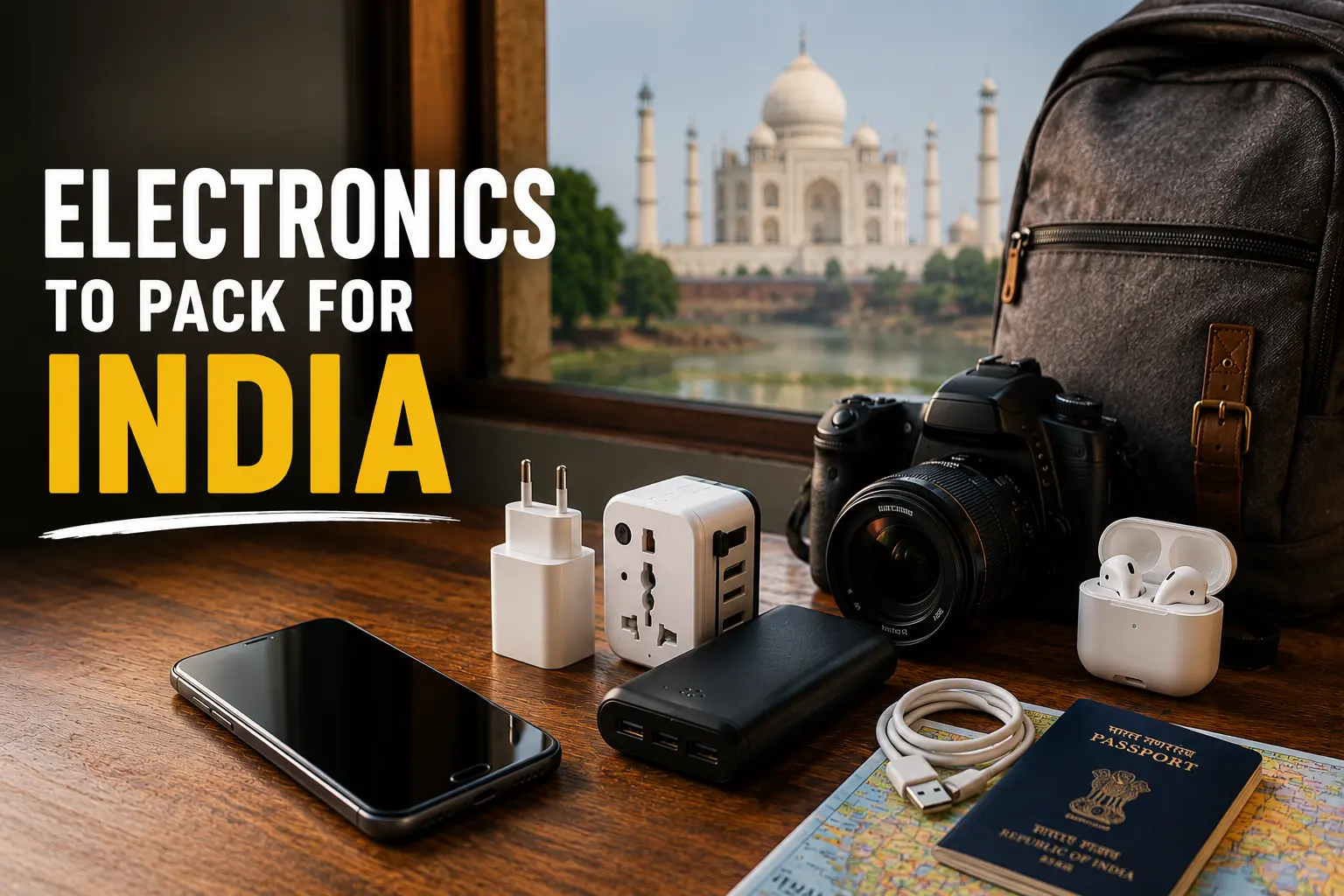
The essential electronics for India travel are:
- Universal travel adapter (Type D for India) — non-negotiable
- Portable power bank (20,000 mAh minimum)
- Unlocked smartphone with offline maps downloaded
- Local Indian SIM card (buy at the airport on arrival)
- Noise-cancelling earbuds for long drives and flights
- Camera (if photography matters to you)
- Charging cables — bring extras of everything
The single most important piece of advice: India's power system runs on 230V at 50Hz — completely different from the USA (120V) and slightly different from Europe (220V). Your American appliances will not work in Indian sockets without both a plug adapter AND a voltage check. Plug in the wrong device and you will damage it permanently.
Understanding India's Power System First
Before we discuss any specific electronics, you need to understand India's unique power situation — because it affects every device you bring.
India's Plug Types
The plug shape used in India is quite different from the one used in the US and most other countries. The India power adapter is known as a "Type D" and works in India, Nepal, Sri Lanka, Bangladesh, Maldives, and Pakistan.
India uses three plug types — C, D, and M — with Type D being the most common in hotels and guesthouses:
|
Your Country
|
Your Plug
|
India Compatible?
|
|
🇺🇸 USA / Canada
|
Type A (2 flat pins)
|
Will NOT fit
|
|
🇬🇧 UK
|
Type G (3 rectangular pins)
|
Will NOT fit
|
|
🇩🇪 Germany / 🇫🇷 France
|
Type C/E (2 round pins)
|
Sometimes fits
|
|
🇦🇺 Australia
|
Type I (angled flat pins)
|
Will NOT fit
|
American tourists' electronics will not work in India unless they have a power adapter compatible with Indian outlets. This is not a minor inconvenience — without the right adapter, none of your devices charge at all.
India's Voltage — The More Important Issue
The typical United States voltage is 120 volts, whereas the voltage in India is 240 volts. This means that unless your electronics can accommodate 240V, the Indian outlet will likely destroy your device.
This is where many travellers make a costly mistake. A plug adapter changes the shape of the plug — it does not change the voltage. If you plug a single-voltage 120V American appliance into an Indian socket using only a shape adapter, you may damage the device permanently.
How to check your device's voltage compatibility: Look at the small print on your device's charger or power brick. If it says:
- "Input: 100-240V" — dual voltage. Only a plug adapter needed.
- "Input: 110-120V only" — single voltage. Needs a voltage converter AND a plug adapter for India.
Most modern laptops, smartphones, and camera chargers are dual voltage (100-240V) and only need a plug adapter. Older American appliances — some hair dryers, electric shavers, and specialty devices — may be single voltage.
India's Power Quality — An Honest Warning
Although India is supposed to be 240V, it is very unpredictable and can spike well below or even high above this voltage level. It is always possible to fry your devices.
This is especially true outside major cities. Power cuts, voltage fluctuations, and brief surges are common in smaller Rajasthani towns — even in mid-range hotels. A surge protector adapter provides meaningful protection for expensive electronics like laptops and cameras.
Item 1 — Universal Travel Adapter with USB Ports
Priority: Non-Negotiable. Buy Before You Leave Home.
A universal travel adapter ensures your devices remain charged. Consider a surge protection adapter to help protect your devices from power fluctuations.
The single most important electronic item to pack for India is a quality universal travel adapter — and I cannot emphasise enough that you should buy this before you leave home, not at the airport.
What to look for in your India travel adapter:
USB-A and USB-C ports built in: For family holidays, multiplug adapters with onboard USB can be a really good choice. Business travelers should ensure they have an appropriate adapter for keeping laptops, notebooks, tablets and phones fully charged. Selecting an adapter with USB-C (or maybe PD for laptops) may be necessary.
A good adapter for India should have:
- Type D pin compatibility (the three round pins of India)
- At least 2 USB-A ports for older device cables
- At least 1 USB-C port for newer phones and laptops
- Surge protection built in — important for India's unpredictable voltage
- Compact, lightweight design
My specific recommendation: Anker Universal Travel Adapter (with USB-C PD) or BESTEK Universal Travel Adapter. Both available on Amazon in the USA and UK before departure. Cost: $15–$30 USD.
What NOT to do:
- Do not buy a cheap no-brand adapter from an airport shop — India's voltage fluctuations can damage both the cheap adapter and the devices connected to it
- Do not assume your hotel will provide adapters — some do, most do not have spares
- Do not buy at an Indian market after you arrive — quality varies enormously and you need it from Day 1
My honest note from experience: I keep spare adapters in my car for guests who forget theirs. In over a decade, I have lent this adapter more times than I can count. The guest who remembered theirs always thanks themselves on the first evening. The guest who forgot always wishes they had listened.
Item 2 — Portable Power Bank (20,000 mAh Minimum)
Priority: Essential. This Will Save Your Trip.
A high-capacity portable power bank is the second most important electronic item for India travel — and one of the most universally thanked items my guests carry.
Why India specifically demands a large power bank:
India's sightseeing days are long. A typical Rajasthan itinerary might involve leaving the hotel at 8 AM, visiting Amber Fort, driving to Jaipur's old city bazaars, lunch, the City Palace, Jantar Mantar, and Nahargarh Fort for sunset — arriving back at the hotel at 7 PM. That is eleven hours of continuous phone use for Google Maps, photography, WhatsApp with family, TripAdvisor reviews, and My Dream India Tour's 24/7 WhatsApp support.
A standard smartphone battery will not survive this. A 20,000 mAh power bank will charge most smartphones 4 to 5 times — comfortably covering even the longest India sightseeing day.
The Anker 737 PowerCore 24K with 24,000 mAh, 140W and 3x USB-C charges MacBook, iPhone, camera and drone simultaneously. For India travel with a phone and camera, a 20,000 mAh bank with at least 2 USB outputs is the practical minimum.
Important airline note: Most airlines allow power banks up to 27,000 mAh in carry-on luggage. Power banks are NOT permitted in checked baggage — always carry yours in your hand luggage. Check your specific airline's policy before departure.
Brands I recommend: Anker PowerCore series, RAVPower, Mophie Powerstation. All available in the USA, UK, Germany, and France before departure.
Charge it fully every night: This is the single most important power bank habit for India travel. Plug in before you sleep. Leave the hotel fully charged.
Item 3 — Unlocked Smartphone
Priority: Essential — Your Most Important India Tool
Your smartphone is your most important travel companion in India — more important than any guidebook, map, or translation app ever printed. It is your:
- Navigation tool (Google Maps with offline India maps downloaded before you arrive)
- Communication device (WhatsApp — India's universal communication platform — for staying in touch with My Dream India Tour's team throughout your journey)
- Translation app (Google Translate with Hindi/Marathi/ Tamil downloaded for offline use)
- Camera for quick shots and video
- Payment tool (many establishments now accept Google Pay and Apple Pay)
- Information resource (monument histories, restaurant reviews, weather forecasts)
- Emergency contact (24/7 access to our tour support team)
Make sure your phone is UNLOCKED before departure: A locked phone tied to your home carrier (AT&T, Verizon, EE, O2, T-Mobile) will either not work on Indian networks or will charge extraordinary international roaming fees. Contact your carrier before departure to confirm your phone is unlocked — or use their international day pass if your carrier offers this at reasonable cost.
Download these before you leave home (for offline use):
- Google Maps — download the India offline map (it is a large file — do this on WiFi)
- Google Translate — download Hindi language pack for offline translation
- XE Currency — for live and offline exchange rates
Item 4 — Indian SIM Card
Priority: Essential — Buy at the Airport on Arrival
This is the single most cost-effective technology decision you will make for your India trip — and one that many international tourists overlook until they are already in India wondering why their data is not working.
Why a local Indian SIM is essential:
India's mobile data is among the cheapest in the world. A tourist SIM from Airtel or Jio provides 2GB of data per day for 28 days for approximately ₹599–₹799 ($7–$10 USD). This is extraordinary value — unlimited navigation, WhatsApp, photography uploads, and video calls for less than the cost of a single day of international roaming from most Western carriers.
Where to buy: The arrivals hall of Delhi, Mumbai, Jaipur, and all major Indian international airports have Airtel and Jio counters specifically set up for tourist SIM purchases. The process takes approximately 15–20 minutes. Bring:
- Your passport (original — they scan it)
- A passport-size photograph (some airports accept a phone photo on a white background — confirm on arrival)
- Your Indian visa/ETA approval document
- ₹800–₹1,000 cash (or a card)
Airtel vs Jio — which is better for tourists? Both work well across major tourist circuits. Airtel has slightly better coverage in remote Rajasthani desert areas (Jaisalmer, Sam Sand Dunes region). Jio offers marginally better value for data quantity. Either will serve you very well throughout a standard India tour itinerary.
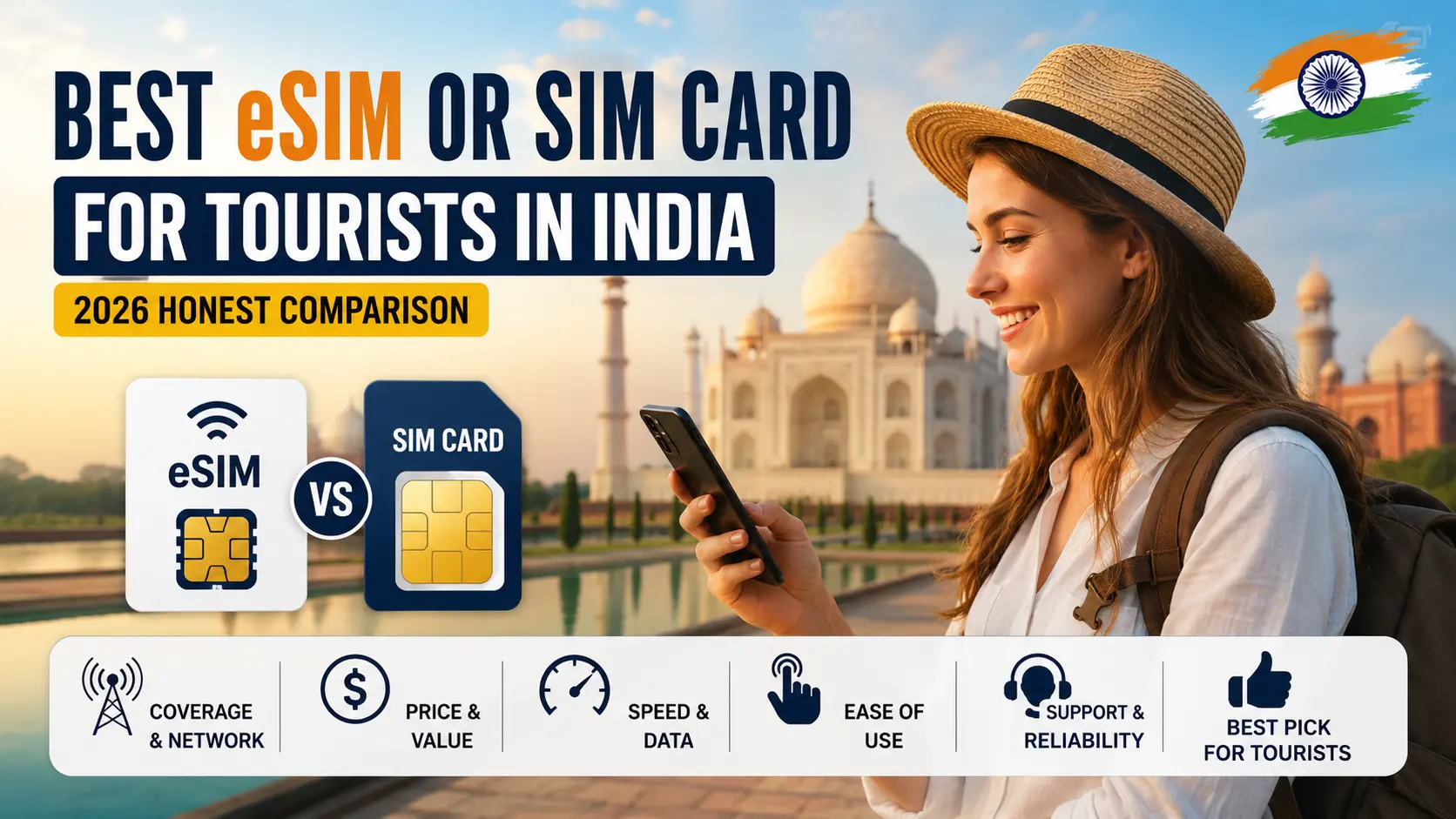
If your phone supports eSIM: Airalo and similar eSIM providers offer India data plans that can be activated before you leave home — no airport queue required. Confirm your phone's eSIM compatibility before departure.
Item 5 — Noise-Cancelling Earbuds or Headphones
Priority: Highly Recommended
India's car journeys between cities are long. Jaipur to Jaisalmer is 5–6 hours. Delhi to Agra is 3.5 hours. Jaisalmer to Jodhpur is 4.5 hours. A quality pair of noise-cancelling earbuds transforms these journeys — from time that passes slowly into time for music, podcasts, audiobooks, phone calls, or simply the meditative pleasure of watching Rajasthan's landscape unfold in comfortable quiet.
Bose QuietComfort Ultra Earbuds are a game changer for 10+ hours of flying per year. For India specifically, noise cancellation is valuable not just on flights but on the long inter-city drives that characterise Rajasthan touring.
My recommendations by budget:
Premium: Apple AirPods Pro, Bose QuietComfort Ultra, Sony WH-1000XM5 — genuine noise cancellation, excellent for both flights and long drives
Mid-range: Jabra Evolve2 55, Soundcore Space Q45 — very good noise cancellation at half the price
Budget: Anker Soundcore Q30 — surprisingly effective noise cancellation for the price
Earbuds vs over-ear headphones for India: Earbuds are more practical for India travel — they fit in your daypack, do not overheat in Rajasthan's climate, and are less conspicuous in crowded markets. Over-ear headphones offer better noise cancellation but generate significant heat in warm weather.
Item 6 — Camera
Priority: Context-Dependent — Read Before Deciding
India is one of the world's great photography destinations. Amber Fort's Sheesh Mahal in morning light, a Bengal tiger crossing a Ranthambore forest track, the Taj Mahal at sunrise, Varanasi's ghats at dusk — these are images worth capturing properly.
The honest question: Do you need a dedicated camera, or will your smartphone camera do?
Your smartphone camera is sufficient if:
- You are not a serious photographer
- You primarily want to share images on social media
- You do not plan to print large photographs
- You want to travel light
Modern smartphone cameras — iPhone 15 Pro, Google Pixel 8, Samsung Galaxy S24 Ultra — produce extraordinary images in good light. For most travellers, a phone camera is entirely sufficient for an India trip.
A dedicated camera is worth bringing if:
- Photography is a primary motivation for your India visit
- You want to capture wildlife at Ranthambore (telephoto lens is essential for tiger photography at distance)
- You want low-light capability for Varanasi's ghat photography at dusk and dawn
- You plan to print large-format photographs
If you bring a dedicated camera, pack:
- Minimum 2 memory cards — card failure is rare but catastrophic when it happens
- Minimum 2 fully charged batteries — camera batteries drain faster in India's heat and dust; charging time in hotel rooms varies
- A cleaning kit — India's dust gets inside everything, including camera bodies and lenses
- A padded camera bag or insert that fits inside your daypack
- A lightweight flexible tripod (Gorilla Pod) for low-light and dawn photography without the bulk of a full tripod
My specific recommendation for India wildlife photography: A telephoto zoom lens of minimum 300mm is needed for meaningful tiger photography at Ranthambore. A smartphone will photograph the experience but not the tiger in detail at typical viewing distances of 20–50 metres.
Item 7 — Laptop or Tablet
Priority: Only If You Actually Need It
I am going to be honest here in a way that most packing guides are not.
Most tourists do not need a laptop for India travel.
If you are travelling for holiday — not business — a smartphone handles navigation, communication, photography, and entertainment entirely. A laptop adds weight, creates security concerns in hotel rooms, and is an additional device to keep charged in India's variable power environment.
Bring a laptop if:
- You are working remotely during your India trip
- You need to edit professional-quality photographs
- You have specific work requirements that your phone cannot fulfil
Leave the laptop at home if:
- You are on holiday
- Your trip is under 14 days
- A tablet or iPad is sufficient for your needs
If you bring a laptop:
- Confirm it is dual voltage (100-240V) — virtually all modern laptops are
- Use a surge protector adapter in Indian hotel rooms
- Never leave it unattended in your room without a security cable lock
- Carry it in your hand luggage — never in checked baggage
Item 8 — E-Reader (Kindle or Similar)
Priority: Highly Recommended for Readers
India's long inter-city drives, early morning waits at monument gates, and quiet heritage hotel evenings create more reading time than most travellers expect. An e-reader is one of the most genuinely appreciated travel companions on a long India tour.
A Kindle Paperwhite is my specific recommendation — lightweight, long battery life (weeks on a single charge), glare-free screen for outdoor reading, and capable of carrying your entire travel reading library.
Load it with India-relevant reading before you leave: The God of Small Things by Arundhati Roy (Kerala), City of Djinns by William Dalrymple (Delhi), Nine Lives by William Dalrymple (India's spiritual traditions), and The Palace of Illusions by Chitra Banerjee Divakaruni (Rajasthan context) are all extraordinary choices that deepen the India experience.
Item 9 — Portable WiFi Router or Travel Router
Priority: For Groups and Remote Workers Only
For solo travellers and couples, an Indian SIM card provides all the connectivity you need at very low cost. A portable WiFi router becomes worth considering if:
- You are travelling in a group of 4 or more who all need data simultaneously
- You are working remotely and need a stable, secure connection beyond what hotel WiFi provides
- You are concerned about hotel WiFi security for banking and sensitive browsing
The GL.iNet Beryl AX travel router provides stable, secure connectivity and can be used with a local SIM for reliable travel internet.
For most holiday travellers — a local Indian SIM is simpler, cheaper, and entirely sufficient.
Item 10 — AirTags or Luggage Trackers
Priority: Recommended — Lightweight Peace of Mind
A 4-pack Apple AirTag in suitcase, backpack, camera bag and drone case works worldwide with zero lost luggage.
India's domestic flights, multiple hotel check-ins, and busy luggage handling environments make a discreet luggage tracker genuinely worthwhile. An Apple AirTag (for iPhone users) or Tile Mate (for Android users) placed inside your main suitcase provides real-time location tracking through India's Find My network.
Cost: $25–$30 USD. Weight: virtually nothing. Peace of mind: considerable.
What NOT to Bring — Electronics Edition
After ten years of guiding international tourists through India, I have a clear list of electronics that create more problems than they solve:
1. Single-voltage American hair dryers (110V) Single-voltage devices have a small voltage range such as 100-120V. They will not be able to handle India's 240V power supply — if used, you will likely end up with a smoking device. India's hotels provide hair dryers. Leave yours at home entirely.
2. Expensive drone without research Drone regulations in India are strict and actively enforced t heritage sites including the Taj Mahal, Red Fort, and most Rajasthan forts. Permits are required and enforcement is genuine. If you want to fly a drone in India, research the regulations thoroughly before departure — or simply leave it home and hire a licensed local drone operator through My Dream India Tour for specific photography needs.
3. Irreplaceable personal electronics India is safe — but physical demands of travel (dust, heat, active fort walks, bumpy rural roads) mean that electronics take more physical punishment than at home. Leave truly irreplaceable items — first-edition iPods, prototype devices, your only copy of a professional camera — in safe storage at home.
4. Multiple heavy chargers A universal adapter with multiple USB ports handles all your charging from a single socket. Pack smart.
The Complete India Electronics Packing List
Print this and check it off before you leave:
Power & Connectivity (Most Critical)
- Universal travel adapter — Type D compatible, with USB-A and USB-C ports, surge protection (buy before departure — Anker, BESTEK)
- Portable power bank — 20,000 mAh minimum (Anker PowerCore, RAVPower)
- Indian SIM card plan researched — buy at airport on arrival (Airtel recommended for Rajasthan coverage)
- Charging cables — USB-C x2, Lightning/USB-A x1 (extras of every cable you use — cables fail) Surge protector adapter — for hotel room sensitive device charging
Core Devices
- Smartphone — confirmed unlocked from home carrier
- Google Maps India offline map — downloaded before flight
- Google Translate Hindi pack — downloaded before flight
- Power bank fully charged — before departure
Photography
- Camera + lens (if bringing dedicated camera)
- Memory cards x2 minimum
- Camera batteries x2 minimum (fully charged)
- Camera cleaning kit
- Gorilla Pod / compact tripod (optional but useful)
Audio & Entertainment
- Noise-cancelling earbuds or headphones
- Charging case fully charged
- E-reader (Kindle) — loaded with India books
Work (If Required)
- Laptop — confirmed dual voltage (100-240V)
- Laptop charging cable
- USB-C hub / docking station (if needed)
- Security cable lock for hotel room
Security & Tracking
- AirTag x2 (suitcase + daypack)
- RFID-blocking wallet or passport holder
Quick Reference — Electronics by Country
|
Item
|
USA
|
UK
|
Germany
|
France
|
|
Adapter needed
|
Type A→D
|
Type G→D
|
Usually
|
Usually
|
|
Voltage check
|
Critical (120V→240V)
|
Minor (230V→240V)
|
Minor
|
Minor
|
|
SIM needed
|
Yes
|
Yes
|
Yes
|
Yes
|
|
Power bank
|
Essential
|
Essential
|
Essential
|
Essential
|
A Final Word — From the Jaipur Airport Arrivals Hall
In ten years of meeting guests at Jaipur's airport, I have seen a clear pattern.
The guests who arrive with a good adapter, a charged power bank, and an Indian SIM card sorted within the first thirty minutes of landing — these guests start their India experience immediately. Map open. WhatsApp to family sent. Camera on.
The guests who spent their first two hours hunting for an adapter in the arrivals hall, buying an overpriced airport SIM they do not fully understand, and waiting for their phone to charge from a hotel room socket they are not sure is working — these guests start their India experience stressed.
Both groups are about to have an extraordinary trip. But the prepared guests get more of it.
Pack the adapter. Charge the power bank. Download the offline maps. Buy the SIM at the airport.
And then put your phone in your pocket, step into Jaipur's morning air, and let India do the rest.
Feel free to reach out with any questions about electronics or India trip preparation. I read and respond to every message personally. Email us at mydreamindiatour@gmail.com or WhatsApp directly at +91-87695-95984.
Plan Your India Tour with My Dream India Tour
Every guest on our tours benefits from our team's on-ground India knowledge — including pre-trip briefings on electronics, adapters, SIM cards, and everything else you need to arrive prepared and confident.
Rajasthan Tours
Golden Triangle Tours
North India Tours
South India Tours
Wildlife Safari Tours
Same Day Tours
WhatsApp / Call: +91-87695-95984 | +91-70625-12828
Email: mydreamindiatour@gmail.com
Website: www.mydreamindiatour.com
Based in: Jaipur, Rajasthan, India
Rated #186 of 1,161 Tours & Activities in Jaipur — TripAdvisor
© 2026 My Dream India Tour Author: Mukesh Sain, Founder & Senior Tour Guide, Jaipur.
Frequently Asked Questions
Q: What power adapter do I need for India from the USA?
You need a Type D travel adapter — the three round-pin plug used in India, Nepal, and Sri Lanka. US Type A plugs (two flat pins) will not physically fit into Indian sockets. Additionally, verify your devices are dual voltage (100-240V) before plugging them in — US standard voltage is 120V and India runs at 240V. Most modern smartphones and laptop chargers are dual voltage, but always check the fine print on your charger.
Q: Can I use my US phone in India?
Yes — if it is unlocked from your home carrier and either supports eSIM or you purchase a local Indian SIM card. Contact your carrier (AT&T, Verizon, T-Mobile) before departure to confirm your phone is unlocked for international use. A local Airtel or Jio tourist SIM purchased at the airport gives you unlimited data for approximately $7-10 USD for 28 days — far better value than international roaming.
Q: Will my laptop work in India?
Most modern laptops are dual voltage (100-240V) and will work in India with just a plug adapter. Check the fine print on your power brick — if it says "Input: 100-240V," you only need a Type D plug adapter. Use a surge protector adapter in hotel rooms to protect against India's occasional voltage fluctuations, particularly in smaller cities and towns.
Q: Is it safe to charge electronics in Indian hotels?
Generally yes in established hotels, though power quality varies. Use a surge protector adapter for valuable electronics. Do not leave devices charging overnight without protection in smaller guesthouses and budget hotels in smaller towns where power fluctuations are more common.
Q: What is the best camera for India travel?
For general travel photography, a modern smartphone camera (iPhone 15 Pro, Google Pixel 8 Pro, Samsung S24 Ultra) is entirely sufficient and infinitely more practical than a dedicated camera. For wildlife photography at Ranthambore or Jim Corbett — where tigers may be 30-50 metres away — a dedicated camera with a 300mm+ telephoto lens produces significantly better images than any smartphone.
Q: Should I bring a VPN for India?
A VPN is worth considering for India travel for two reasons: security on hotel WiFi networks, and access to streaming services that may be geo-restricted from India. However, India does not block major international websites or social media — a VPN is a nice-to-have, not an essential.


.jpg)









.jpg)
.jpg)
.jpg)




.webp)