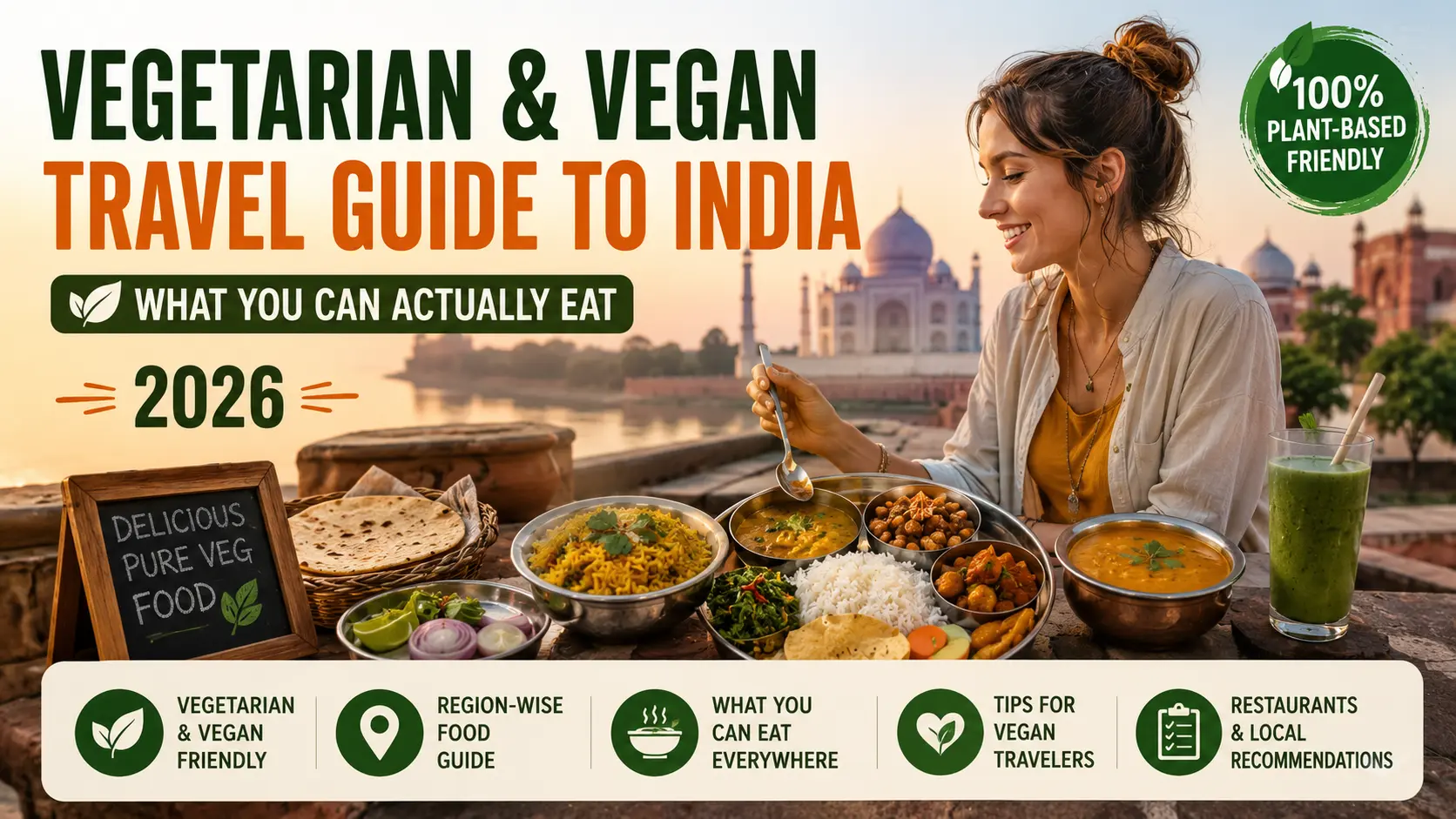
Vegetarian and Vegan Travel Guide to India: What You Can Actually Eat (2026)
By Mukesh Sain | Founder & Senior Tour Guide, My Dream India Tour Based in: Jaipur, Rajasthan, India Last Updated: August 2026 | Reading Time: 14 minutes
I want to start with something that surprises almost every vegetarian and vegan guest I guide through Rajasthan.
India is not automatically a paradise for plant-based eaters — but it is genuinely close to one, in a way that no other country on earth quite matches. The nuance is important: Indian vegetarian food is one of the world's great culinary traditions, but Indian vegetarian food is not automatically vegan. Dairy is deeply sacred in Hindu culture — ghee, butter, milk, yoghurt, and paneer appear generously in cooking without always being mentioned on a menu.
Once you understand this distinction — and once you know the right dishes, the right phrases, and the right places to eat — India becomes the most extraordinary food destination for plant-based travellers anywhere in the world.
I have guided hundreds of vegetarian and vegan guests from the USA, UK, Canada, Germany, France, and Australia through India's food landscape. This guide is the one I wish every one of them had read before they arrived.
Is India Good for Vegetarians and Vegans?
For vegetarians: India is exceptional. No country is as creative with its vegetarian diet as India. In many regions — particularly Rajasthan and Gujarat — vegetarianism is the majority, not the exception.
For vegans: India is very good — with specific knowledge. The challenge is hidden dairy (ghee, butter, milk) that appears in dishes without being announced. With the right phrases and the right food knowledge, vegan eating in India is entirely achievable and deeply rewarding.
|
Dietary Need
|
India Rating
|
Key Challenge
|
|
Vegetarian
|
⭐⭐⭐⭐⭐ Excellent
|
Almost none
|
|
Vegan
|
⭐⭐⭐⭐ Very Good
|
Hidden ghee/dairy
|
|
Gluten-free vegan
|
⭐⭐⭐ Good
|
Rice-based South India easier
|
|
Raw vegan
|
⭐⭐ Challenging
|
Limited raw options
|
|
Jain vegetarian
|
⭐⭐⭐⭐⭐ Excellent
|
Widely understood in India
|
The Most Important Thing to Understand First
The good news is that vegetarianism is deeply respected across India, and in many regions it is the default rather than the exception. The slightly more nuanced news is that Indian vegetarian food is not automatically vegan. Dairy is sacred in Hindu culture — ghee, milk, yogurt, and paneer are considered pure and auspicious, which means they appear generously in cooking without always being mentioned on a menu.
What this means practically:
- Vegetarian: you can eat almost everywhere in India freely
- Vegan: you need to specifically ask about ghee, butter, milk, and paneer in dishes that may not list them
The single most useful phrase you will learn:
"Kya ismein ghee, doodh, ya paneer hai?" Translates to: "Does this contain ghee, milk, or paneer?"
In tourist areas and larger cities, saying "I am vegan — no dairy, no ghee, no butter, no milk, no cheese" in English is usually understood, especially in restaurants used to international visitors.
What "Pure Veg" Means in India: And Why It Matters
One of the most useful things to know as a vegetarian or vegan travelling in India is the significance of "Pure Veg" restaurant signs.
In Jaipur and Jodhpur, look for pure vegetarian restaurants (marked "Pure Veg" on the sign) where the kitchen works without any meat, making cross-contamination concerns minimal.
Pure Veg = 100% vegetarian kitchen. No meat, no fish, no eggs are ever cooked or stored in a Pure Veg kitchen. This eliminates all cross-contamination concerns for vegetarians completely.
Pure Veg does NOT automatically mean vegan. Dairy (ghee, butter, paneer, yoghurt) is used freely in Pure Veg kitchens — it is considered pure and sacred in Hindu tradition.
Sattvic restaurants go one step further — no onion, no garlic, and often minimal dairy. These are the most naturally vegan-friendly kitchens in India, typically found near temples and ashrams.
Jain restaurants are excellent for strict vegetarians and often accommodate vegans — no meat, no eggs, no root vegetables (onion, garlic, potato, carrot are excluded in strict Jain cooking). Jain vegetarian food is found throughout Rajasthan and Gujarat.
Naturally Vegan Indian Dishes: The Complete List
This is what I tell every vegan guest before their tour begins: India has an extraordinary range of dishes that are naturally vegan without any modification. You are not limited. You are not eating "vegan versions" of real food. You are eating some of the finest food India produces.
North India & Rajasthan: Naturally Vegan Dishes
Dal (Lentil Curry): India's most eaten dish. Plain dal — whether dal tadka, dal fry, or the thin Rajasthani dal — is naturally vegan when made without ghee tempering. Ask: "Bina ghee ke" (without ghee). Dal makhani (black lentils with butter) is NOT vegan but dal tadka without ghee is completely vegan.
Aloo Sabzi (Potato Curry): Dry-spiced potato preparations are a Rajasthani staple and almost always vegan. Found at every restaurant and dhaba.
Chana Masala: Spiced chickpeas cooked in tomato and onion gravy. Naturally vegan. One of India's greatest dishes and completely plant-based.
Rajma: Kidney beans in a rich spiced tomato sauce. Naturally vegan. A North Indian favourite.
Ker Sangri: A dry dish made from desert beans and dried berries, ker sangri is often naturally vegan and one of the most unique flavor profiles you will encounter anywhere in Indian cooking. This is Rajasthan's most distinctive traditional dish — found in Jaisalmer, Jodhpur, and Jaipur's traditional restaurants.
Baingan Bharta: Roasted and mashed aubergine/eggplant with spices and tomatoes. Naturally vegan. Smoky and extraordinary.
Sabzi/Vegetable Curry: Any sabzi (vegetable dish) made with seasonal vegetables in spiced tomato base. Ask about ghee — many are naturally vegan.
Roti/Chapati: Unleavened whole wheat flatbread. Naturally vegan unless brushed with ghee or butter at serving — ask for it plain ("bina ghee").
Puri: Deep-fried whole wheat bread. Naturally vegan.
Poha: Flattened rice dish with mustard seeds, curry leaves, turmeric, and vegetables. One of India's finest breakfasts and completely plant-based.
Upma: Semolina cooked with vegetables and spices. Usually vegan (check for ghee). Widely available at breakfast.
Aloo Paratha without butter: Stuffed whole wheat flatbread with potato filling. Request it without butter or ghee — the result is still excellent.
South India: A Vegan Paradise
From South Indian staples such as dosa, idli, rasam and sambar to North Indian rotis, curries, chutneys, dal, and an array of street foods, the country offers an abundance of options that are naturally vegan.
South India is, in my experience, the easiest region of India for vegan eating. The cuisine is built on rice, lentils, vegetables, and coconut — with far less reliance on dairy than North Indian cooking.
Masala Dosa: A paper-thin fermented rice and lentil crepe, crisp at the edges, filled with spiced potato. The dosa itself is vegan; the potato filling is vegan; the coconut chutney is vegan; the sambar (lentil soup) is vegan. This is one of the world's great vegan dishes — and it costs approximately ₹50–150 ($0.60–$1.80 USD).
Idli: Steamed rice and lentil cakes. Naturally vegan. Served with coconut chutney and sambar — both vegan. The definitive South Indian breakfast.
Sambar: A thin, tamarind-based lentil and vegetable soup. Almost always vegan. Served at every South Indian restaurant with every meal.
Rasam: A thin peppery tamarind soup with tomatoes and spices. Naturally vegan. Deeply warming and medicinal.
Coconut Chutney: Ground coconut with green chilli, ginger, and curry leaves. Always vegan. Served with every South Indian breakfast.
Rice and Curry ("Meals"): South India's equivalent of the thali: a banana leaf loaded with rice, multiple vegetable curries, rasam, sambar, and pickle. Most of the dishes are naturally vegan — ask which contain dairy.
Avail: Kerala's classic mixed vegetable dish cooked in coconut milk and curd. Usually vegan when made without curd — a beautiful dish.
Appam: Kerala's lacy fermented rice crepe. Naturally vegan. Extraordinary with vegetable stew (ask for coconut milk version — "nariyal ke doodh ke saath").
Uttapam: A thicker, softer version of dosa topped with onions, tomatoes, and green chilli. Naturally vegan.
Street Food — Naturally Vegan Options
India's street food scene is one of the world's great culinary experiences — and much of it is naturally vegan:
Pani Puri / Gol Gappa: Crispy hollow puris filled with tangy tamarind water and spiced chickpea filling. Completely vegan. India's most beloved street snack.
Bhel Puri: Puffed rice with vegetables, tamarind chutney, and chopped onion. Naturally vegan.
Chaat: A catch-all term for tangy, spicy street snacks. Most chaat is vegan; some versions include yoghurt (dahi) — ask before ordering.
Samosa: Deep-fried pastry with spiced potato and pea filling. Usually vegan — ask if the pastry contains butter (some do). The filling is almost always vegan.
Vada Pav: Mumbai's beloved street food — a spiced potato patty in a soft bun with chutneys. Completely vegan.
Pakoras: Vegetables dipped in chickpea batter and deep fried. Naturally vegan. Extraordinary with chai.
Fresh Coconut: Available everywhere in South India. The perfect vegan snack, hydrating drink, and afternoon treat.
Hidden Dairy: What to Watch For
This is the most important section for vegan travellers. Here are the dishes that seem vegan but often are not:
Dal Makhani: Made with cream and butter. Not vegan.
Palak Paneer / Saag Paneer: Spinach with paneer cheese. Not vegan. However — ask for "palak aloo" (spinach with potato) instead. Almost always available and completely vegan.
Naan: Many naan recipes use yoghurt and butter. Ask for "tandoori roti" or "chapati" instead — both wheat-based flatbreads that are typically vegan.
Biryani: Often cooked with ghee. Ask specifically. Vegetable biryani can sometimes be made vegan.
Kheer: A rice pudding dessert made with milk. Definitely not vegan.
Lassi: A yoghurt-based drink. Not vegan. Substitute with fresh fruit juice, coconut water, or nimbu pani (fresh lime water with sugar and salt — completely vegan).
Halwa: A sweet dessert often made with ghee, milk, and flour. Not vegan.
Most Indian sweets (Mithai): Made with milk, cream, and ghee. Generally not vegan.
Paratha: Often brushed with generous amounts of butter or ghee after cooking. Request "bina ghee, bina makhan" (without ghee, without butter) when ordering.
Essential Hindi Phrases for Vegetarian and Vegan Travellers
Print these or save them on your phone before your trip:
For Vegetarians:
|
Phrase
|
Hindi
|
Use When
|
|
I am vegetarian
|
Main shakahari hoon
|
At every restaurant
|
|
No meat, no fish, no eggs
|
Gosht nahi, machli nahi, anda nahi
|
Ordering at any restaurant
|
|
Is this vegetarian?
|
Kya yeh shakahari hai?
|
Checking a dish
|
|
Pure vegetarian restaurant
|
Shuddh shakahari
|
Looking for Pure Veg
|
For Vegans:
|
Phrase
|
Hindi
|
Use When
|
|
I am vegan
|
Main vegan hoon
|
At restaurants (widely understood now)
|
|
No dairy, no ghee, no butter
|
Dairy nahi, ghee nahi, makhan nahi
|
Critical phrase for vegan eating
|
|
Does this contain ghee, milk, or paneer?
|
Kya ismein ghee, doodh, ya paneer hai?
|
Checking any dish
|
|
Without ghee please
|
Bina ghee ke please
|
Ordering dal, roti, sabzi
|
|
Without butter
|
Bina makhan ke
|
Ordering naan, paratha
|
|
Only vegetables
|
Sirf sabziyan
|
Clarifying your order
|
Your most important phrase to learn before you land: "Kya ismein ghee, doodh, ya paneer hai?" This translates to "Does this contain ghee, milk, or paneer?"
Vegetarian and Vegan Food by Region: City-by-City Guide
Jaipur — Rajasthan's Pink City
The Rajasthan region is the center of India's vegetarian cuisine. With more than 75% of the population identifying as vegetarian, it is a kind of expert in the field.
Jaipur is an extraordinary city for plant-based eating. The majority of its population is vegetarian, "Pure Veg" signs are everywhere, and the traditional Rajasthani cuisine is one of India's most naturally plant-based regional cooking traditions.
Best vegetarian / vegan dishes in Jaipur:
- Dal Baati Churma: Rajasthan's most iconic dish. Wheat dumplings baked in a wood fire, served with rich dal and sweet crumbled wheat. Traditionally served drenched in ghee. Request it without ghee and the result is still deeply flavorful. The dal and churma components can be vegan.
- Ker Sangri: Desert beans and dried berries. Naturally vegan. One of the most extraordinary flavour profiles in all of Indian cooking.
- Pyaaz ki Kachori: Deep-fried pastry with spiced onion filling. Usually vegan. Jaipur's most beloved street breakfast.
- Ghevar: A Rajasthani festival sweet made with flour and sugar syrup. Some versions are vegan — ask if milk is used.
Best Pure Veg restaurants in Jaipur:
- Rawat Misthan Bhandar — famous for pyaaz kachori
- Laxmi Mishthan Bhandar (LMB) — traditional Rajasthani
- Chokhi Dhani — Rajasthani village experience (evening)
- Peacock Rooftop — rooftop dining, vegan options available
Jodhpur — The Blue City
Jodhpur's food scene is deeply vegetarian — the city has a significant Jain and Marwari community, both of which practise strict vegetarianism.
Best dishes:
- Mirchi Bada — Jodhpur's signature street snack. A massive green chilli stuffed with spiced potato, dipped in chickpea batter, and deep fried. Completely vegan and extraordinary.
- Mawa Kachori — A sweet pastry (dairy-based — not vegan)
- Dal Baati — Same as Jaipur. Request without ghee.
- Lasun ki Chutney — Garlic chutney served with most Rajasthani meals. Naturally vegan.
Tip for Jodhpur: The area around the clock tower market (Ghanta Ghar) has the highest concentration of authentic Pure Veg eateries in the city.
Jaisalmer — The Golden Desert City
Jaisalmer's remote desert location means its cuisine is simple, hearty, and built around ingredients that keep well in the arid climate.
Best dishes:
- Ker Sangri — Most authentic here, in its home territory
- Bajra Roti — Pearl millet flatbread. Naturally vegan. Served with Rajasthani dal and pickle.
- Gatte ki Sabzi — Chickpea flour dumplings in spiced yoghurt gravy. Ask for a vegan version (tangy tomato base instead of yoghurt).
- Desert camp dinner — Most luxury desert camps in Jaisalmer offer fully vegetarian Rajasthani thalis. Tell your camp operator in advance for vegan modifications.
Udaipur — The City of Lakes
Udaipur is one of Rajasthan's most vegan-friendly cities for tourists — the proliferation of rooftop cafes serving international visitors means most restaurants are now familiar with vegan requests.
Best dishes and restaurants:
- Cafe Millets of Mewar — Udaipur's most dedicated healthy eating restaurant, with extensive vegan options made from local millets, vegetables, and plant-based ingredients
- The Savage Garden — Rooftop restaurant, vegan options clearly marked
- Traditional Rajasthani thali restaurants near the City Palace — ask for vegan modifications
Kerala — South India's Vegan Heaven
Kerala is the single most vegan-friendly state in India for international tourists — its rice and coconut-based cuisine is naturally plant-based in a way that North Indian cooking is not.
From South Indian staples such as dosa, idli, rasam and sambar to an array of street foods, the country offers an abundance of options that are naturally vegan.
Best dishes:
- Appam with vegetable stew (coconut milk version)
- Puttu — steamed rice cylinders with kadala curry (black chickpea curry). Naturally vegan.
- Sadya — Kerala's traditional banana leaf feast. Many dishes on the banana leaf are naturally vegan.
- Kerala meals at local "meals" restaurants — among the best value vegan eating in the world at ₹80–150 ($1–1.80 USD) for a full thali
Delhi — Best Vegan Restaurants in India's Capital
Delhi has the most developed international vegan restaurant scene in India — particularly in South Delhi's Hauz Khas, Greater Kailash, and Khan Market areas.
Best vegan options:
- Vegano India (Hauz Khas) — India's most dedicated vegan restaurant chain
- Kunafa (Khan Market) — Middle Eastern vegan options
- Chokhi Dhani (Vasant Kunj) — Pure Veg Rajasthani
- Every Udupi restaurant in Delhi — South Indian Pure Veg, most dishes naturally vegan
The Vegetarian Thali — India's Greatest Meal
Vegetable Thali — a platter-style meal served on a metal tray, consisting of small portions of rice, dal, vegetables, roti, dahi (yoghurt), chutney or pickle.
The thali is India's most democratic meal — a single round tray loaded with small portions of multiple dishes, designed to provide balanced nutrition and extraordinary variety at low cost.
For vegetarians: A thali is perfect — just eat everything and enjoy.
For vegans: A thali can be adapted. The dal, sabzi (vegetable curry), roti, rice, and pickle components are typically vegan or easily made vegan. The dahi (yoghurt) on the side — skip it. Ask the restaurant to serve your thali "bina dahi, bina ghee" (without yoghurt, without ghee).
In Ahmedabad, thali restaurants like Gordhan Thal serve enormous vegan-friendly spreads for around 300 to 400 rupees (€3 to €4.50) where the food keeps coming until you genuinely cannot eat anymore.
Top Tips for Vegetarian and Vegan Travellers in India
Tip 1: Always Say "Pure Veg" When Looking for Restaurants The words "Pure Veg" on a restaurant sign mean the kitchen never handles meat. For vegetarians, this eliminates all cross-contamination concerns. Look for the green dot logo (vegetarian) versus red dot (non-vegetarian) on all packaged food products in India.
Tip 2:South Indian Breakfast Is Your Best Friend Most breakfast buffets in hotels across India serve at least a few South Indian options like poha, upma, idli and dosa. Those can be your safest bets as other Indian options such as paratha and pav bhaji may contain butter or ghee.
Tip 3: Highway Dhabas Are Mostly Vegetarian Your private driver can guide you to trusted local restaurants with authentic flavors and clean kitchens. Large chain restaurants like Haldiram's, Bikanervala, or Café Coffee Day are safe bets on major routes. In South India, Adyar Ananda Bhavan (A2B) and Saravana Bhavan are clean, consistent, and 100% vegetarian.
All My Dream India Tour drivers know which roadside restaurants are clean, trustworthy, and Pure Veg on every route between Rajasthan's cities.
Tip 4: Nimbu Pani Is the Best Vegan Drink in India Fresh lime water (nimbu pani) with sugar and black salt is India's greatest beverage — refreshing, hydrating, cheap, and completely vegan. Order it everywhere. Coconut water (direct from a green coconut) is equally excellent and widely available.
Tip 5: Carry Snacks for Remote Areas Between Jodhpur and Jaisalmer (4.5 hours), between cities in rural Rajasthan, or on wildlife safaris — reliable vegan snacks can be harder to find. Pack: roasted nuts, fresh fruit, packaged energy bars, and Haldiram's brand namkeen (spiced rice puffs, roasted peas — most varieties are vegan).
Tip 6: Fruit Is Everywhere and Always Safe Banana, papaya, pomegranate, mango (in season), guava, apple, orange — fruit stalls are on every major street in every Indian city. Fresh, inexpensive, and always vegan. Your go-to snack between meals.
Tip 7: Tell Your Tour Operator in Advance If you are travelling with My Dream India Tour, tell us your dietary requirements when you book — not when you arrive. We brief every restaurant, every hotel, and every dhaba stop on your itinerary about your specific needs before you arrive, ensuring vegan or vegetarian meals are prepared and ready rather than improvised at the table.
Vegan at Heritage Hotels and Luxury Properties
Most of Rajasthan's heritage hotels and 5-star properties are fully equipped to serve vegan guests — but only if you communicate your requirements in advance.
My Dream India Tour's pre-trip briefing includes notification to every hotel on your itinerary about dietary requirements. At luxury desert camp properties in Jaisalmer, for example, the traditional Rajasthani thali dinner can be fully veganised with 24 hours' notice — the kitchen substitutes ghee with oil, removes paneer, and ensures the curries are dairy-free throughout.
Without advance communication, even the finest Rajasthani heritage hotels may default to ghee-heavy traditional preparations. With it — they produce extraordinary vegan Rajasthani food.
The Grocery Store Survival Kit — What to Buy in India
For additional snacking or self-catering moments, here is what I recommend vegan guests look for in Indian supermarkets and convenience stores:
Naturally Vegan Packaged Options:
- Haldiram's Bhujia — spiced gram flour snacks
- Haldiram's Aloo Bhujia — potato-based snacks
- Roasted peanuts and cashews — available everywhere
- Parle-G biscuits — check label (some contain milk)
- Digestive biscuits — read labels carefully
- Fresh fruit — widely available at street stalls
- Packaged coconut water (Dabur, Real brands)
- Nimbu pani sachets — pure vegan electrolyte drink
Always Read Labels: Look for the green dot (vegetarian) and then specifically check for "milk solids," "butter," "ghee," or "dairy" in the ingredients list.
A Final Word — From a Jaipur Food Guide
Of all the dietary concerns international guests bring to India, vegetarian and vegan eating is genuinely the easiest to accommodate. Not because India compromises — but because India's food tradition is one of the world's great vegetarian culinary cultures.
The guest who arrives in Jaipur knowing that dal baati churma can be requested without ghee, that Pure Veg signs are their best friend, and that South Indian breakfasts are always a safe haven — this guest eats extraordinarily well throughout their India trip.
The guest who arrives not knowing these things eats defensively — missing some of the finest food on earth out of unnecessary caution.
India is extraordinary for plant-based travellers. Know what to ask for. Know the phrases. And then eat with complete confidence.
Feel free to reach out with any food or trip planning questions before your India visit. I respond to every message personally. Email us at mydreamindiatour@gmail.com or WhatsApp at +91-87695-95984.
Plan Your Vegetarian India Tour with My Dream India Tour
Every My Dream India Tour guest receives a full dietary briefing as part of our pre-trip service. We brief every hotel, restaurant, and dining stop on your itinerary about your specific dietary requirements — ensuring your India trip is extraordinary from the first meal to the last.
Rajasthan Tours, Golden Triangle Tours, Wildlife Safari Tours, North India Tours, South India Tours, Same Day Tours
WhatsApp / Call: +91-87695-95984 | +91-70625-12828
Email: mydreamindiatour@gmail.com
Website: www.mydreamindiatour.com
Based in: Jaipur, Rajasthan, India
Rated #186 of 1,161 Tours & Activities in Jaipur — TripAdvisor
© 2026 My Dream India Tour Author: Mukesh Sain, Founder & Senior Tour Guide, Jaipur.
Frequently Asked Questions
Q: Is India good for vegetarians?
In reality, no country is as creative with its vegetarian diet as India. You will find so many amazing vegetarian dishes that you might not want to leave without taking some with you. India is exceptional for vegetarians — particularly in Rajasthan and Gujarat where vegetarianism is the majority practice. Pure Veg restaurants are everywhere, menus are extensive, and the creativity of Indian vegetarian cooking is unmatched globally.
Q: Is India vegan friendly?
Yes — with specific knowledge. It is possible to survive and hop from one vegan-friendly eatery to another with ease in India. The key is understanding that Indian vegetarian food is not automatically vegan (dairy is used extensively), knowing which dishes are naturally vegan, and using the correct Hindi phrases to request dairy-free preparation. South India is easier for vegan eating; North India requires more communication but is entirely manageable.
Q: What can vegans eat in India?
An extraordinary range: chana masala, dal (without ghee), rajma, aloo sabzi, ker sangri, masala dosa, idli, sambar, rasam, coconut chutney, appam, avial, pani puri, bhel puri, chaat (without dahi), samosas (check pastry), vada pav, pakoras, poha, upma, chapati/roti (without ghee), rice dishes, and most South Indian meals. India's naturally vegan food options are significantly more extensive than most tourists expect.
Q: How do I say vegan in Hindi?
The word "vegan" (वीगन) is understood in tourist areas and modern restaurants. For clearer communication, say: "Main vegan hoon — ghee nahi, makhan nahi, doodh nahi, paneer nahi" (I am vegan — no ghee, no butter, no milk, no paneer). The most important phrase: "Kya ismein ghee, doodh, ya paneer hai?" (Does this contain ghee, milk, or paneer?)
Q: Is Rajasthan good for vegetarians?
The Rajasthan region is the center of India's vegetarian cuisine. With more than 75% of the population identifying as vegetarian, it is a kind of expert in the field. Rajasthan is exceptional for vegetarians — Pure Veg signs are everywhere, traditional Rajasthani cuisine is largely plant-based, and the Marwari and Jain communities have shaped one of the world's great vegetarian food cultures.
Q: Is naan vegan?
Not always. Many naan recipes include yoghurt and are brushed with butter after cooking. Ask specifically, or order chapati or tandoori roti instead — both are typically vegan when ordered without the ghee topping. Say "bina ghee, bina makhan" when ordering any flatbread.
Q: Is dal vegan in India?
Plain dal (dal tadka, dal fry) is naturally vegan. However, many restaurant versions are finished with a ghee "tadka" (tempering) poured over the top. Always ask: "Bina ghee ke" (without ghee). Dal makhani (black lentils) is made with butter and cream — it is not vegan. Yellow dal tadka without ghee is one of the finest and most reliably vegan dishes you will find throughout India.
Q: What should vegetarians avoid in India?
Virtually nothing — India's Pure Veg restaurants eliminate all concern about meat cross-contamination. At non-Pure Veg restaurants, dishes can be mixed. For peace of mind: choose Pure Veg restaurants (look for the sign), avoid dishes described as "makhani" (butter-based), and in South India specify that you do not want fish or egg if the restaurant serves both.
Q: Can I eat street food as a vegan in India?
Yes — much of India's street food is naturally vegan. Pani puri, bhel puri, chana masala, samosas (check the pastry), aloo tikki (potato patties — usually vegan), and pakoras are all excellent vegan street food options. Always clarify about ghee or yoghurt toppings when ordering chaat. My Dream India Tour guides take guests to specific trusted street food vendors on our Jaipur and Delhi street food tours — always with dietary briefings in advance.
Q: Which is the most vegetarian friendly city in India?
India has the world's first vegetarian city — Palitana in Gujarat, where it is illegal to slaughter animals or sell meat and eggs. Among major tourist cities, Jaipur and Ahmedabad are the most comprehensively vegetarian — over 75% of their populations practise vegetarianism. Bangalore has recently been declared the most vegan-friendly city, with a multitude of restaurants and markets serving tasty meat-free foods.
Q: Is India safe for vegans with dairy allergies?
Dairy is used extensively in North Indian cooking — in ghee, butter, paneer, yoghurt, and milk — often without being listed on menus. If you have a serious dairy allergy (not just a vegan preference), communicate this very clearly using the English word "allergy" which is understood at tourist restaurants. Inform My Dream India Tour at booking and we will ensure every dining stop on your itinerary is briefed in advance. South Indian meals (rice, lentils, vegetables, coconut) are safer for dairy-sensitive travellers than North Indian cooking.


.jpg)














.jpg)
.jpg)
.jpg)




.webp)